
Titanium Cells
Factory Direct RP25 Pool Chlorinator Electrolytic Cell with 7 Titanium Plates
titanium electrode, salt chlorinator electrode, titanium anode, replacement salt cell, salt chlorine generator cell, MMO coated titanium electrode, pool chlorinator parts, OEM titanium electrodes
Titanium electrode, salt chlorinator electrode, titanium anode, replacement salt cell, salt chlorine generator cell, MMO coated titanium electrode, pool chlorinator parts, OEM titanium electrodes.
Pool Equipment Accessories / Titanium Electrode
Titanium Electrodes for Salt Chlorinators: A Complete Buyer's Guide to Replacement Salt Cells
RP25 (Salt Chlorinator, also known as Salt Chlorine Generator) Operating Principle
One-sentence summary: Salt is pre-dissolved in the pool water. As the circulating water flows through the electrolytic cell, low-voltage direct current (DC) electrolyzes the saline water, generating hypochlorous acid on-site for sterilization. The "RP" stands for the Reverse Polarity automatic self-cleaning version.
1. System Components
- Power Control Box: Takes AC220V input and steps it down to output a low-voltage DC ($\approx 7\text{V}$, max $25\text{A}$) to the electrolytic cell. Features adjustable chlorine output percentage, timer, polarity reversal, and water flow/salinity protection.
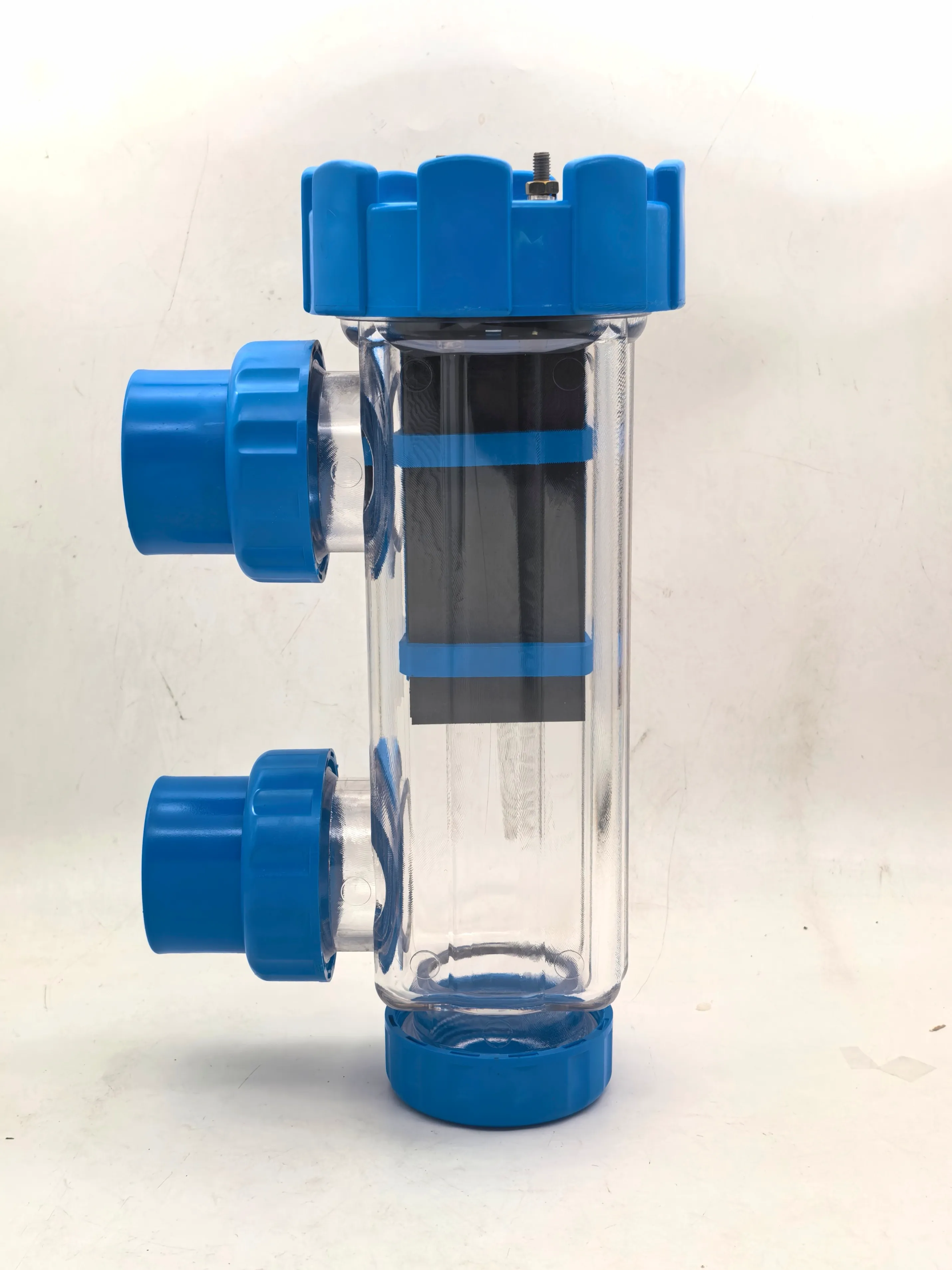
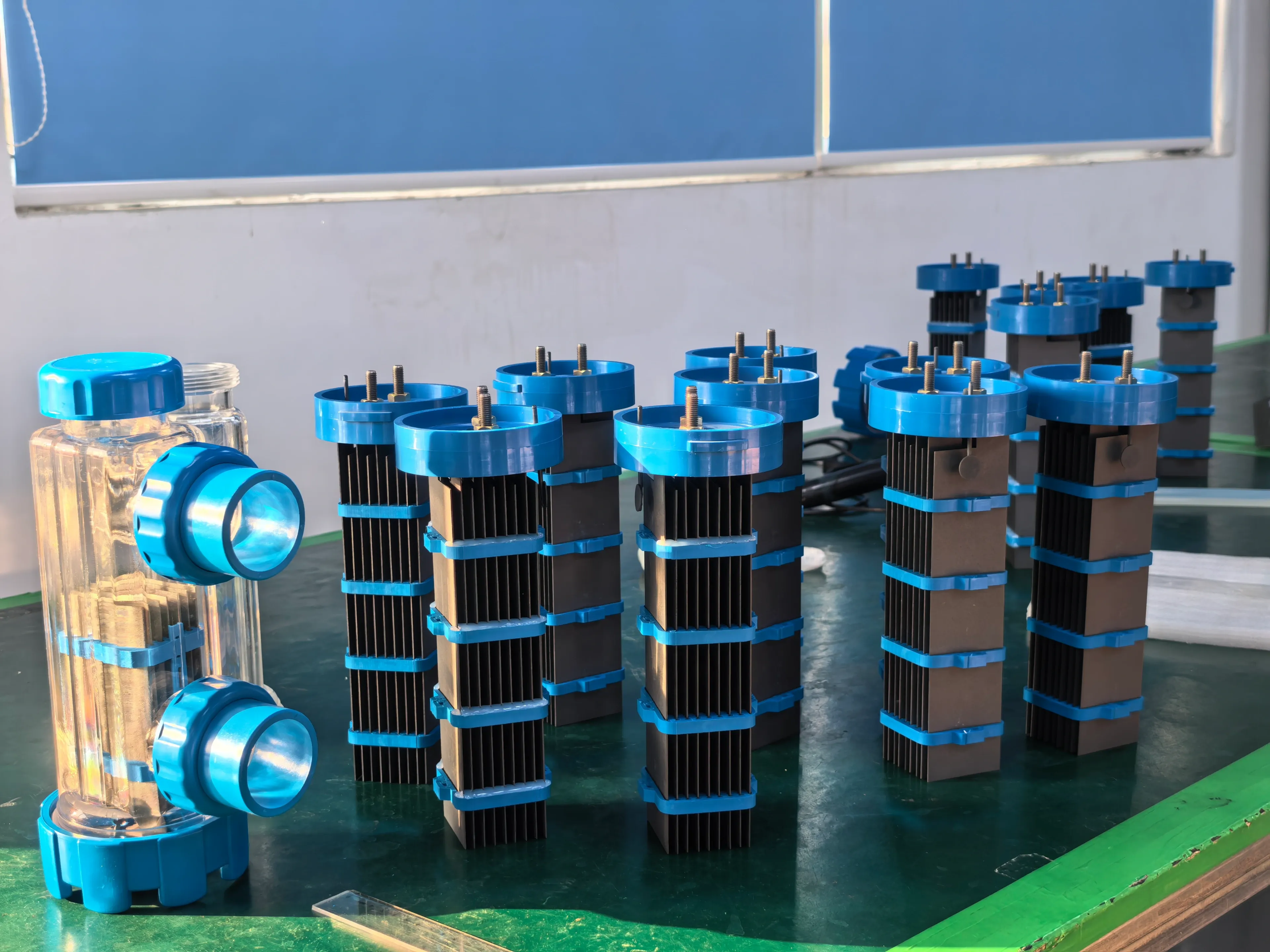
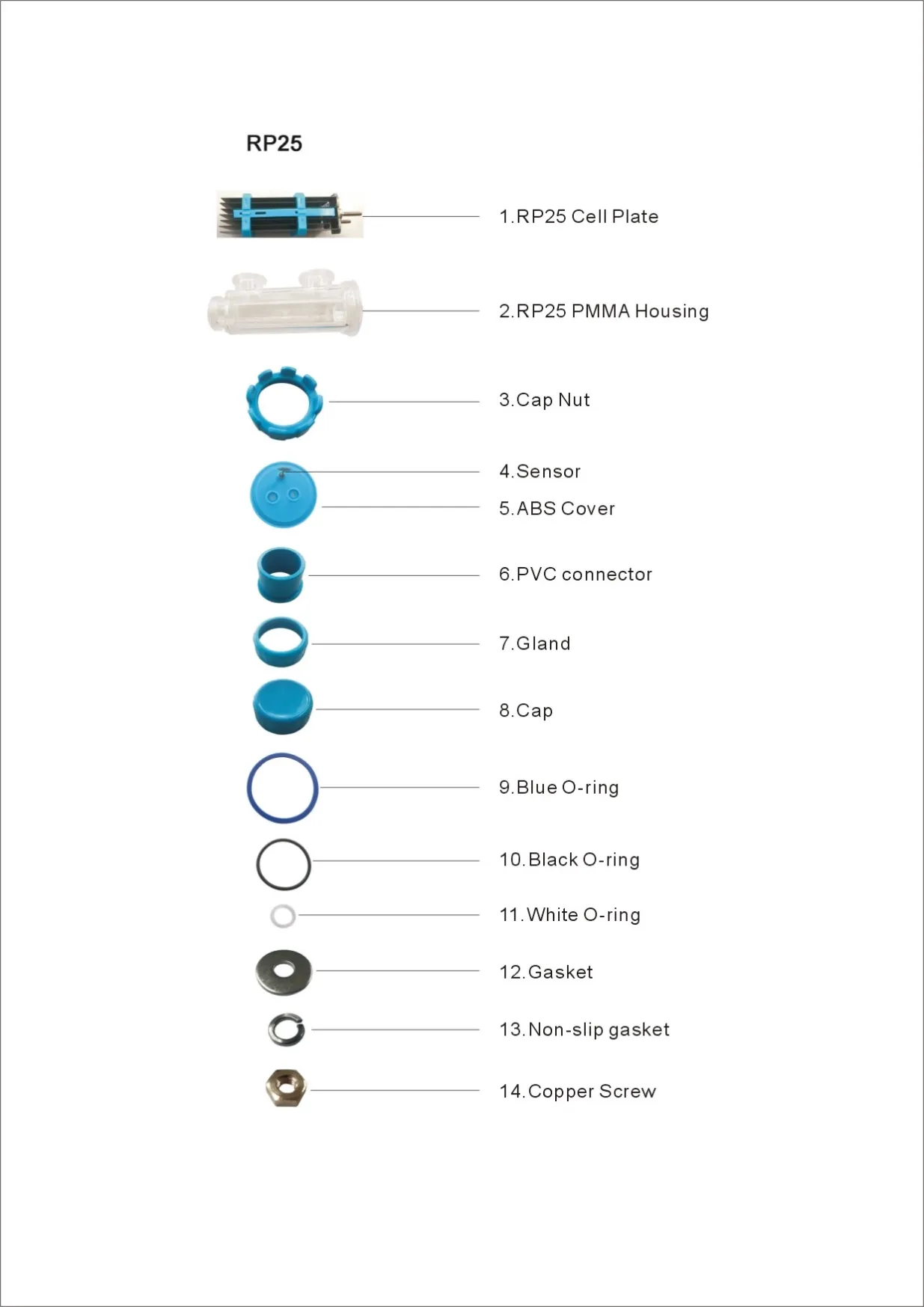
- Electrolytic Cell (Salt Cell): Consists of multiple titanium plates coated with precious metals, with water flowing between the plates.
- Water Flow Switch: Automatically stops electrolysis when there is no water circulation (preventing hydrogen accumulation and dry-firing damage to the plates).
- Supporting Equipment: Works alongside a sand filter and circulation pump to form the pool circulation system.
2. Electrolytic Chemical Reactions
- Salt is added to the pool ($\text{NaCl}$, RP25 standard salinity $4500\text{–}5000\text{ ppm}$), dissolving into chloride ions and sodium ions:$$\boldsymbol{2NaCl + 2H_2O \xrightarrow{\text{Electricity}} 2NaOH + H_2\uparrow + Cl_2\uparrow}$$
- Anode (+): Chloride ions lose electrons $\rightarrow$ generate chlorine gas ($\boldsymbol{Cl_2}$).
- Cathode (−): Water gains electrons $\rightarrow$ releases hydrogen gas ($\boldsymbol{H_2}$, bubbles are carried away by the water flow).
- Chlorine gas reacts immediately with water:$$\boldsymbol{Cl_2 + H_2O = HOCl + HCl}$$
- ✅ Hypochlorous acid ($\text{HOCl}$) is the actual disinfecting agent, which oxidizes and destroys bacteria, algae, and viral proteins to sanitize the pool water.
- Key Point: After disinfection is complete, chlorine reverts back to chloride ions. The salt is recycled continuously and hardly consumed; salt levels only decrease due to pool splash-out, water replacement, or rainwater dilution.
3. RP Reverse Polarity Self-Cleaning (Core Feature of RP25)
- Standard Fixed-Polarity Models: The local $\text{pH}$ around the cathode is very high, causing calcium and magnesium ions in the water to precipitate and form calcium carbonate scale on the plates. As the scale thickens $\rightarrow$ current decreases, chlorine production drops, and overheating occurs, requiring manual disassembly and acid washing.
- RP (Reverse Polarity): Automatically switches the positive and negative poles at set intervals (RP25 defaults to reversing every ~8 hours):
- The cathode that previously accumulated scale becomes the anode, turning the local environment weakly acidic. The scale loosens and is washed away by the water flow, significantly reducing the frequency of manual acid washing.